Thursday, July 21, 2011

Honey Harvest!


This field of winter cress came into bloom about two weeks before we started to harvest. It's several acres big and alive with bees. The day we took honey the bees were so concerned with flying here that they barely bothered us. A situation like this is called a honey run. July 2011 honey will contain winter cress, sumac, dandelion, fruit tree, catapula, basswood, and garden flowers. Since both bee yards have good access to Smith College there'll also be some gingko honey in there!


Priscilla gears up by clothes-pinning her pants shut. Beekeepers know something running down your legs is sweat, something running up is trouble.


Priscilla takes the first super of honey from me. A super is the box the bees put the honey in. A hive body is the box bees raise brood in. This box weighs about 40+ pounds. Note the lack of veils and gloves. The bees were really mellow throughout. We did put them on later but after disturbing all the hives in the yard the bees are bound to get a little testy.


Priscilla holds up a perfect frame of honey. This frame is so perfect we should have saved it for a county fair entry. That is what success looks like. A frame like this will only be drawn by a strong hive with good nectar foraging options.


Priscilla, Erin and I inspect a hive for removable frames with well-capped honey. Erin is our bee "intern". The relationship is pretty informal but Erin helps out around the bee yard learning about how to keep bees. She's a sustainable agriculture grad student at UMass and a Smith grad. She helped set up Smith College's community garden program. We're confident Erin will put her education to good use. She's super smart and fun to be around.


We use an herbal substance called Bee Quick to clear supers of bees. It was made by a company called Fisher's, and contains a blend of herbs that bees don't like to smell, so most move out of the super. It's sprayed on a board that is positioned above the hive and the bees just move down into the lower parts of the hive. A few stragglers are always left. Priscilla uses a leaf blower I had laying around to clear the rest of the bees off. It works amazingly well. The bees just get blown out of the top and don't even seem mad - maybe a bit confused. They just sail back to their hive. This is common practice but we had never used it before. I feel that it's less disruptive to the hive and way fewer bees are harmed than the older process where bees are brushed off each frame.


This little mini hive is called a nuc, short for nucleus Colony. It contains a queen and some workers and a little bit of brood. We use them as a back-up in case a hive goes queenless. The laying queen with consort is accepted quickly by the hives and things go back to normal quick. While we were working in the yard we looked into all the hives to see that things were going well.

The queen in this hive is from a USDA breeding program that uses stock from the Siberian region of Russia.


During the hot day we took several swims in the Mill River to cool off. Priscilla is seen here after harvest and before extracting, the process by which honey is removed from the comb. She's standing in front of the greenhouse we use as a honey house. The very warm temperatures in there help the honey flow out of combs and eventually into bottles with a minimum of trouble. I love the fact that it's surrounded by bee-friendly flowers.


Here is the final haul of supers stacked in the honey house. We left plenty of honey on the hives for the bees to use and they are still flying strongly to plants in the field. It's best practice to always leave enough honey for a hive to winter over successfully.


We started to process the honey after dark, so the bees would stay back in their hive. We tried to process during the day once before and it was like the house was under attack by bees. I guess that's because it was under attack by bees.


Priscilla cuts the caps off the honey so we can put it in the extractor to be spun out. She has a great touch with this. When done just right the cappings come off in roll like this. She uses a heated electric knife to do this. It's just warm to the touch, not hot.


The honey-containing frames are then spun in our Maxant extractor, made in Ayer MA. The spinning action slings the honey onto the inside of the extractor where it collects at the bottom and...


...finally pours out the bottom through a course strainer, and passes into the stainless steel bottling tank. All our equipment is stainless including the strainer. The strainer is course and frequently overflows so a lot of wax, pollen and propolis wind up in the honey. These are all safe and natural hive products. Pollen in honey is reputed to help with allergies and loaded with protein and amino acids. Propolis has a lot of medicinal properties including being an antibiotic capable of killing MRSA, the super bacteria found in hospitals. Our honey practically defines raw unfiltered.


We worked until 2 AM processing, as we didn't want to leave a lot of honey in the house to attract bees. We finally gave up and went home to bed.


We returned the next day to to bottle our liquid sunshine.


We placed the used equipment in the back of this field for the bees to clean off. They harvest a surprising amount of honey from the equipment.


The bees then cleaned out any honey spilled in the bed of our pickup.


And finally everyone went home and back to their regular jobs.

Saturday, July 16, 2011

Philomena

My Mom, Philomena, paints all our bee keeping equipment. To say that my mom does a good job is a real understatement. She's over 80 years old but can outwork people of 1/4 her age. She's seen here in the backyard painting bee hives on the picnic table. My 85 year old dad sits to the left "supervising" her.

Most of our bee keeping equipment comes from an outfit called Brushy Mountain. It's a family-owned business with wood working shops in North Carolina and Pennsylvania. I guess we're just keeping on with the "family" theme here because my mom has painted well over 100 hive bodies.

She paints on primer and two coats of paint, sanding between coats for a perfect finish. The hives come out beautiful. It also ensures a very long life for every hive.

When we assemble the hives we use coated nails and also glue both surfaces of each joint. This makes the hives super strong.

We make sure every hive body is square using a tool called a speed square. When we have time we coat the mating surfaces of the hive with bees wax so they don't stick together.

The bees themselves finish the process coating the inner surfaces with a substance called propolis. It's made from the sap of the wounds of trees and plants. The trees secrete special substances to prevent from getting infected. It's been shown that hives with lots of propolis inside are healthier. The wood inside can have the look of a fine resin-coated antique.

In all when we think about sustainability we often think about where materials came from and the like. But it's important to also think about how long something will last. We try and buy the best, longest lasting equipment we can. We build it the best way we can and try and treat it well thereafter. I am confident many of the hive bodies we have will last into the next decade and I have special reason to want them to.

Quite apart from Yankee frugality, good business sense and sustainability my own mom helped me out by doing a wonderful job painting these hives. She's going great but at an age when her friends and family are starting to pass on, so it can be on my mind that she will too in a time not too far distant.

I am glad to have something that I can work work with that she's had her hand on. I'll think of her and my dad sitting in the back yard and all her crazy shims and methods for getting the paint just right.

Thursday, July 14, 2011

Maxant 3100H

We recently purchased a Maxant 3100H extractor. An extractor is machine that spins combs of honey like a centrifuge. It separates the honey from the comb in a way that we can give it back to the bees so they don't have to build it all over again. For us, this single piece of equipment was a large expense.

We drove out to Ayer, MA to get it. We could have bought a similarly specified extractor for less elsewhere, but this one is made in Massachusetts. By this I don't mean it's assembled from parts in MA but it's made "whole cloth" right here in the greatest state in America. Let me point out that we have marriage equality and we also invented the truly public library. The American Revolution was born here and Aerosmith is from Boston. Really, what more can you ask for? It's important for us to support people with similar values to ours and to support businesses that deliver good lives for the families of their workers.

The drum of the extractor comes there as sheets and is bent and welded right in Ayer by third generation metal workers that get paid a living wage. The baskets that hold the frames are made in Worcester, even the nuts and bolts are sourced from American companies. The motor and motor control were foreign made, from England and Taiwan respectively but when we spoke the to the owner of Maxant he said he tried to source American components but couldn't find any parts domestically that would work as well.

As much as we are able to, we like to know that our money goes to people who are able to earn a decent wage and live a good life. The purchase of our Maxant extractor is one way of making sure that happens.

It was also important for us to meet the people that made our extractor. We now have a relationship with our supplier, which is something I cannot get from an online catalog. Yeah, so it would have been cheaper and easier not to drive to Ayer and just to have had a Chinese made extractor delivered to our door, but we didn't.

We don't ever plan to get huge and be some giant company. We just want to do what we enjoy doing, keeping bees healthy and productive and learning about the world in the process. Sometimes that means identifying flowers and sometimes that means driving to Ayer to meet the people that made something we need. I think this extractor is made better than the than most I have seen and I think it will handle our needs forever. So, for the rest of my life I can look at this piece of equipment and know I have done right by someone.

All our equipment is American made. Out hives are made either in Pennsylvania or Maine and out foundation and frames are made in California or here on the east coast. We recently switched to the California supplier of foundation, the wax the bees are given to start drawing comb on, because they used domestically sourced bees wax that tests as chemical free. We also feel the product is more durable and longer lasting.

Our glass jars come from Andler Packaging whose Springfield MA office has served generations of Pioneer Valley folks. Yes, the glass jars are American made. Do you get it yet? We're serious about this.

Whenever we can we choose American made, and the more local the better. I'm not a patriot, not in the sense of a flag waving, but we do believe that our money should flow to companies that support their workers. American Made helps us know that's true, but there's nothing like meeting people face to face to know we got it right.

Bye the way, it's also why we're proud that our honey is availble exclusively through River Valley Market.

Massachusetts, rock on.

Tuesday, May 3, 2011

A long tough winter.

The blossoms are out on our pear tree and on trees all over the neighborhood. It's a hopeful time, and now we need hope.

The winter was amazingly hard on our bees, and we lost lots of them. We entered winter with 22 hives and now we have around a dozen, I can't recall exactly. The combination of a dry hot end to summer and fall wasn't kind to our bees. Without nectar colonies didn't produce so many young bees and most of our hives entered the winter with small colonies of older bees. On some years this could have been OK, but last winter got cold and stayed cold and we had a long cold spring.

Without a January thaw or even some warm days in April our bees stayed hive bound. Even now, cool day temperatures keep too many bees from flying even though there's nectar and pollen in dandelions and in the blossoms of pear and apple trees around neighborhood.

Much of this was my reaction to last years wintering strategy. I in the fall of 2009 managed the hives to be large and powerful going into winter. I wrapped all the hives and filled extra supers (boxes) with maple leaves for a kind of attic insulation. This allowed the bees to use less honey over the winter staying warm. I fed the bees in early spring and whoa! did we ever have bees. We had so many bees that it seemed like we had a swarm every couple of minutes.

Resolving not to repeat that I cut way back on feeding and wrapping hives. The long winter and slow spring took a lot of colonies. I am learning that a good maple syrup season can mean a tough spring for bees.

Well, that's behind us now. With pear blossoms abundant we hope for warm days and lots of flying weather.

Agriculture teaches things in a way that's especially hard. In school when we missed the deadline for a paper we could make an excuse but agriculture doesn't listen. Many years ago I worked for a farmer named Tom Baggot. I had a great deal of responsibility for a very young man. Occasionally I would make mistakes and sometimes costly and complex mistakes.

Inevitably I would come to Tom and say, "I'm sorry" and try and explain how the mistake had come to be made. Tom would always say. "Adam, I am not interested in that. Explain to me how things are now so that we can make a plan to move forward." He could be mad or moody or exasperated when I told him how things were wrong, but he always brushed it off an looked forward.

Agriculture doesn't care why you made the mistake, it's simply asks if you're moving forward. We are.

Wednesday, August 25, 2010

Signs and Wonders


My sister sent a note to me saying it had been a "great summer!" meaning we'd had good beach weather. It's true, we had more sunny, hot days this summer than any I can remember. All that heat and sun meant we had a drought. A big patch of our lawn browned up. You can see it in the crowns of some trees that started showing fall color in mid-August.

We started the year with an amazing spring. We had just the mix of sun and rain to produce a huge bonanza of nectar! Everyone was optimistic, including the bees, who took it as a signal to swarm! Swarms, really, are a sign of optimism. Bees think to themselves, "Hey, conditions are pretty good, the days are still getting longer, I bet we can split and form a new hive! Whaddaya say!" More or less, a swarm is like a business opening another office someplace.

The great spring gave way to a hot dry summer. Not much bloomed, and what did didn't have much nectar it in. In drought conditions plants don't put out much abundance and try and hang on until conditions improve.

Our bees, which took off like a rocket in May, were in stasis by the end of June. You can tell this because the bees which had been furiously drawing comb in early Just just stopped when nectar stopped coming in. You can see this because the partly drawn comb is no longer white, but yellow. It sounds funny, but it's because the bees walked on it with dirty feet!

Around August 1st I saw bees on Queen Anne's Lace. A sure sign that everything had gone from bad to worse. Queen Anne's Lace is a plant of last resort that bees turn to when there is nothing else. It's the bee equivalent of taking a job at MacDonald's.

Last week two wonderful things happened:
  1. It rained more than an inch for the first time since June. I put a glass on our deck looked outside and watched it fill over the course of the day. We slept on our enclosed porch for two nights to listen to the rain fall on the roof. I walked across the back yard to the compost bins in my socks and didn't mind at all when they get soaking wet.
  2. The tall goldenrod came into bloom. The early goldenrod had been out, but is apparently of little use to the bees. The world is gold again. Like the dandelions that have come to symbolize the abundance of spring, their fall sisters arrive to rescue our girls from the nectar dearth that is midsummer in Western Massachusetts.
I think, in the end, that 2010 for beekeepers nearby will be remembered as a dry year. Maybe, if the frost comes late and we get a bit more rain we'll come to remember how the strong fall honeyflow was this year.

Though summer isn't over, I can now look back over enough of it to see the greater pattern of much of it. I can see how our actions managing the bees fit in with the bees themselves and the environment we operated in. I wonder what I could have done differently, and wonder what to do now.

Sometimes we see into the past no better than we can predict the future. Yet, this year, I am beginning to see how our bees, my actions, and the progression of the year interacted. Beekeeping means reading signs, either from the bees or from the environment. It means interpreting these correctly and acting appropriately. I don't think any of this is possible without wonder.

There is a sweet-sourdough smell that comes from a strong hive processing lots of goldenrod nectar. In late afternoon when the field bees have returned it's quite pronounced in front of several hives hard at their work. Somehow, here, I feel a fellow traveler with our bees and the land.

I am sure of this at least: I will not lack for wonder.

Friday, July 30, 2010

What's blooming locally, and local queens.

I have started to look at the Bloom Board over at the New England Wild Flower Society to get an idea of what's happening out in the world away from the hive. It's turned into a great resource for finding out where our bees are going. It's been dawning on me that my hive management is such a small, small part of what happens to our bees. The rest is what's going on away from the hive, in the natural world.

Here's a list for what's blooming at Garden in the Woods, which is meant to showcase southern New England wildflowers. Since they're only about 60 miles from our apiary, it's also a pretty good bet that this is what's blooming here. So, when I am trying to understand what's available to our bees I start here--it helps me with identifying plants. I've highlighted plants that are at least are decent honey plants.

Of these, the most exciting is goldenrod. Early goldenrod isn't a super plant, but it's the first of the goldenrod that will make the bulk of our honey this year. Tall goldenrod comes later, and when it arrives the real show starts!

Actea pachypoda (white baneberry)

Actea racemosa (black bugbane)

Allium cernuum (nodding onion)

Allium plummerae (Tanner’s canyon onion)

Asclepias incarnata (swamp milkweed)

Asclepias tuberosa (butterfly weed)

Baptisia tinctoria (yellow wild indigo)

Blephilia hirsuta (hairy wood mint)

Callirhoe digitata (winecup)

Callirhoe involucrata (purple poppy mallow)

Cephalanthus occidentalis (common buttonbush)

Clethra alnifolia (coastal sweet pepperbush)

Coreopsis verticillata (threadleaf tickseed)

Diphylleia cymosa (American umbrella leaf berries)

Echinacea purpurea (purple coneflower)

Eschscholzia california cv. Aurantiaca orange (California poppy)

Eupatoriadelphus fistulosus (hollow-stemmed Joe-pye weed)

Eupatoriadelphus purpureum (Joe-pye weed)

Euphorbia corollata (flowering spurge)

Euribia divaricata (white wood aster)

Filipendula rubra (queen of the prairie)Heliopsis helianthoides

Gaillardia aristata (common blanket flower)

Helenium autumnale (common sneezeweed)

Helianthus microcephalis (small-headed sunflower)

Helianthus tuberosa (Jerusalem artichoke sunflower)

Heliopsis helianthoides (oxeye daisy)

Heuchera micantha (small-flowered alumroot)

Hydrangea quercifolia (oak-leaved hydrangea)

Hydrastis canadensis (goldenseal – fruit)

Hypericum prolificum (shrubby St. John’s-wort)

Impatiens pallida (pale touch-me-not)

Liatris pycnostachya (prairie blazing star)

Lobelia cardinalis (red lobelia)Monarda didyma

Lobelia siphilitica (great blue lobelia)

Lysimachia quadrifolia (whorled yellow loosestrife)

Lysimachia terrestris (swamp yellow loosestrife)

Mimulus moschatus (musky monkey-flower)

Mimulus ringens (Allegheny monkey-flower)

Monarda didyma (scarlet bee balm)

Monarda fistulosa (wild bee balm)

Nymphaea odorata (white water lily)

Petalostemum purpureum (purple prairie clover)

Phlox divaricata cv. alba (white wood phlox)

Phlox paniculata cv. Blue Boy (summer phlox)

Physostegia (obedient plant)

Pontederia cordata (pickerel weed)

Pycnanthemum icanum (hoary mountain mint)

Ratibida pinnata (gray-headed Mexican hat)

Rhododendrom prunifolium (plum-leaf azalea)

Rudbeckia hirta (black-eyed coneflower)

Ruellia humilis (wild petunia)Sarracenia purpurea

Sarracenia flava (yellow pitcher plant foliage)

Sarracenia oreophila (mountain pitcher plant foliage)

Sarracenia purpurea (purple pitcher plant)

Saururus cernuus (lizard’s tail)

Silphium perfoliatum (rosinweed or cup plant)

Solidago juncea (early goldenrod)

Spigelia marilandica (Indian pink)

Symphyotrichum linariifolius (stiff aster)


As an aside here, my dad was president of the American Wild Flower thing-or-some-such when I was in my teens. I love my dad a lot, so learning about this now is something that I feel especially good about.

In other news, we're making up some new "nucs" (short for Nucleus Colonies) with special queens. Roger from the Franklin County Bee Keepers has offered us a queenly daughter (princess?) queen that is supposed to be especially resistant to mites. We've also started a couple of queens from Lagrant's. He's a second generation local bee keeper who breeds queens right here in western MA. Most of our queens come from Dan Conlon of Warm Colors Apiary. We like Dan's queens because they come from just up the road from us, about 8 miles from here.

Local means a lot in bee keeping. As an example, bees that hoard honey and respond strongly to changes in day length do better in someplace like New England, since we have long, cold winters compared to someplace like Georgia. We're starting to breed our own queens now, but queens from people like Dan keep local beekeepers like us going.

Tuesday, July 27, 2010

Through the Eyes of a Servant


In my teens and twenties I played at being a trout fisherman. Spare time took me into the woods to stumble along the banks of streams and narrow rivers. Along the way I began to notice vegetation and soil types, the makeup of the trees and the feel of the ground under foot. I looked at the plunge of water and where light came over hills and into valleys. I learned about nature, but for the purpose of catching fish.

In my twenties and thirties I worked for a farm in Connecticut. I once worked a 106 hour work week and did many 18-hour days. We planted corn, squash and other market garden crops on 1600 acres scattered from south of Hartford to north of Springfield. I learned to identify weeds; I became familiar with sumac. I learned how water flows across and through the soil by watching newly plowed land dry after rains, and much later seeing how crops grew. I learned about nature, but for the purpose of growing crops.

In my thirties I moved to California and took up surfing. I spent hundreds or thousands of hours watching waves break on the shore. I learned about what makes a wave strong, how the land and wind affect its shape. I became familiar with the things that live there, in the dangerous boundary between earth and sea. I learned about nature, but for the purpose of surfing.

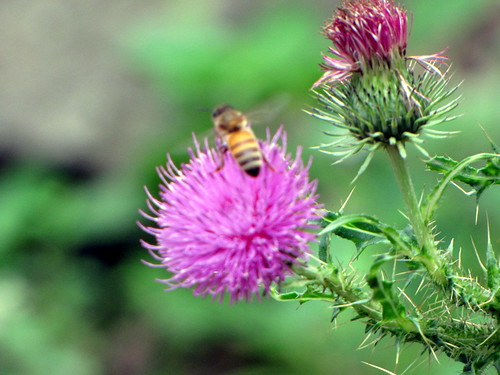
This morning I went up to Andy's to see the bees. When I was there I wondered where they were going. I allowed myself the time to wander from the hive to see where the girls were working. I found some on Queen Ann's Lace, early goldenrod and a kind of thistle I later identified as Canada thistle.

In my wanderings this morning I felt again that searching that I have so many times been party to. I tend to learn from and wander through the natural world when I have given myself some sort of mission. It could be fishing, farming or surfing. I rarely go abroad with binoculars or a guide book to observe for the sake of observation. I don't know if this is good or bad, I just know this is how I am.

When, at liberty this morning, I did wander the fields in search of my girls the great panopoly of things that may be observed by me, were observed by me. There, amidst the grass and thistle, I became again a servant of mission. It is a wonder to think of them aloft above the heads of rich and poor alike, alighting on hundreds of thousands or millions of flowers each day, a thousand times too many for me to even imagine, even had I had the whole day and all the tea in China.

It occurred to me then that for the first time, I was not looking for something for myself, I was looking for where my bees were making their fortune, and that all the work done back at the hive merely prepares them for the changes in the land.