Tuesday, May 3, 2011

A long tough winter.

The blossoms are out on our pear tree and on trees all over the neighborhood. It's a hopeful time, and now we need hope.

The winter was amazingly hard on our bees, and we lost lots of them. We entered winter with 22 hives and now we have around a dozen, I can't recall exactly. The combination of a dry hot end to summer and fall wasn't kind to our bees. Without nectar colonies didn't produce so many young bees and most of our hives entered the winter with small colonies of older bees. On some years this could have been OK, but last winter got cold and stayed cold and we had a long cold spring.

Without a January thaw or even some warm days in April our bees stayed hive bound. Even now, cool day temperatures keep too many bees from flying even though there's nectar and pollen in dandelions and in the blossoms of pear and apple trees around neighborhood.

Much of this was my reaction to last years wintering strategy. I in the fall of 2009 managed the hives to be large and powerful going into winter. I wrapped all the hives and filled extra supers (boxes) with maple leaves for a kind of attic insulation. This allowed the bees to use less honey over the winter staying warm. I fed the bees in early spring and whoa! did we ever have bees. We had so many bees that it seemed like we had a swarm every couple of minutes.

Resolving not to repeat that I cut way back on feeding and wrapping hives. The long winter and slow spring took a lot of colonies. I am learning that a good maple syrup season can mean a tough spring for bees.

Well, that's behind us now. With pear blossoms abundant we hope for warm days and lots of flying weather.

Agriculture teaches things in a way that's especially hard. In school when we missed the deadline for a paper we could make an excuse but agriculture doesn't listen. Many years ago I worked for a farmer named Tom Baggot. I had a great deal of responsibility for a very young man. Occasionally I would make mistakes and sometimes costly and complex mistakes.

Inevitably I would come to Tom and say, "I'm sorry" and try and explain how the mistake had come to be made. Tom would always say. "Adam, I am not interested in that. Explain to me how things are now so that we can make a plan to move forward." He could be mad or moody or exasperated when I told him how things were wrong, but he always brushed it off an looked forward.

Agriculture doesn't care why you made the mistake, it's simply asks if you're moving forward. We are.

Wednesday, August 25, 2010

Signs and Wonders


My sister sent a note to me saying it had been a "great summer!" meaning we'd had good beach weather. It's true, we had more sunny, hot days this summer than any I can remember. All that heat and sun meant we had a drought. A big patch of our lawn browned up. You can see it in the crowns of some trees that started showing fall color in mid-August.

We started the year with an amazing spring. We had just the mix of sun and rain to produce a huge bonanza of nectar! Everyone was optimistic, including the bees, who took it as a signal to swarm! Swarms, really, are a sign of optimism. Bees think to themselves, "Hey, conditions are pretty good, the days are still getting longer, I bet we can split and form a new hive! Whaddaya say!" More or less, a swarm is like a business opening another office someplace.

The great spring gave way to a hot dry summer. Not much bloomed, and what did didn't have much nectar it in. In drought conditions plants don't put out much abundance and try and hang on until conditions improve.

Our bees, which took off like a rocket in May, were in stasis by the end of June. You can tell this because the bees which had been furiously drawing comb in early Just just stopped when nectar stopped coming in. You can see this because the partly drawn comb is no longer white, but yellow. It sounds funny, but it's because the bees walked on it with dirty feet!

Around August 1st I saw bees on Queen Anne's Lace. A sure sign that everything had gone from bad to worse. Queen Anne's Lace is a plant of last resort that bees turn to when there is nothing else. It's the bee equivalent of taking a job at MacDonald's.

Last week two wonderful things happened:
  1. It rained more than an inch for the first time since June. I put a glass on our deck looked outside and watched it fill over the course of the day. We slept on our enclosed porch for two nights to listen to the rain fall on the roof. I walked across the back yard to the compost bins in my socks and didn't mind at all when they get soaking wet.
  2. The tall goldenrod came into bloom. The early goldenrod had been out, but is apparently of little use to the bees. The world is gold again. Like the dandelions that have come to symbolize the abundance of spring, their fall sisters arrive to rescue our girls from the nectar dearth that is midsummer in Western Massachusetts.
I think, in the end, that 2010 for beekeepers nearby will be remembered as a dry year. Maybe, if the frost comes late and we get a bit more rain we'll come to remember how the strong fall honeyflow was this year.

Though summer isn't over, I can now look back over enough of it to see the greater pattern of much of it. I can see how our actions managing the bees fit in with the bees themselves and the environment we operated in. I wonder what I could have done differently, and wonder what to do now.

Sometimes we see into the past no better than we can predict the future. Yet, this year, I am beginning to see how our bees, my actions, and the progression of the year interacted. Beekeeping means reading signs, either from the bees or from the environment. It means interpreting these correctly and acting appropriately. I don't think any of this is possible without wonder.

There is a sweet-sourdough smell that comes from a strong hive processing lots of goldenrod nectar. In late afternoon when the field bees have returned it's quite pronounced in front of several hives hard at their work. Somehow, here, I feel a fellow traveler with our bees and the land.

I am sure of this at least: I will not lack for wonder.

Friday, July 30, 2010

What's blooming locally, and local queens.

I have started to look at the Bloom Board over at the New England Wild Flower Society to get an idea of what's happening out in the world away from the hive. It's turned into a great resource for finding out where our bees are going. It's been dawning on me that my hive management is such a small, small part of what happens to our bees. The rest is what's going on away from the hive, in the natural world.

Here's a list for what's blooming at Garden in the Woods, which is meant to showcase southern New England wildflowers. Since they're only about 60 miles from our apiary, it's also a pretty good bet that this is what's blooming here. So, when I am trying to understand what's available to our bees I start here--it helps me with identifying plants. I've highlighted plants that are at least are decent honey plants.

Of these, the most exciting is goldenrod. Early goldenrod isn't a super plant, but it's the first of the goldenrod that will make the bulk of our honey this year. Tall goldenrod comes later, and when it arrives the real show starts!

Actea pachypoda (white baneberry)

Actea racemosa (black bugbane)

Allium cernuum (nodding onion)

Allium plummerae (Tanner’s canyon onion)

Asclepias incarnata (swamp milkweed)

Asclepias tuberosa (butterfly weed)

Baptisia tinctoria (yellow wild indigo)

Blephilia hirsuta (hairy wood mint)

Callirhoe digitata (winecup)

Callirhoe involucrata (purple poppy mallow)

Cephalanthus occidentalis (common buttonbush)

Clethra alnifolia (coastal sweet pepperbush)

Coreopsis verticillata (threadleaf tickseed)

Diphylleia cymosa (American umbrella leaf berries)

Echinacea purpurea (purple coneflower)

Eschscholzia california cv. Aurantiaca orange (California poppy)

Eupatoriadelphus fistulosus (hollow-stemmed Joe-pye weed)

Eupatoriadelphus purpureum (Joe-pye weed)

Euphorbia corollata (flowering spurge)

Euribia divaricata (white wood aster)

Filipendula rubra (queen of the prairie)Heliopsis helianthoides

Gaillardia aristata (common blanket flower)

Helenium autumnale (common sneezeweed)

Helianthus microcephalis (small-headed sunflower)

Helianthus tuberosa (Jerusalem artichoke sunflower)

Heliopsis helianthoides (oxeye daisy)

Heuchera micantha (small-flowered alumroot)

Hydrangea quercifolia (oak-leaved hydrangea)

Hydrastis canadensis (goldenseal – fruit)

Hypericum prolificum (shrubby St. John’s-wort)

Impatiens pallida (pale touch-me-not)

Liatris pycnostachya (prairie blazing star)

Lobelia cardinalis (red lobelia)Monarda didyma

Lobelia siphilitica (great blue lobelia)

Lysimachia quadrifolia (whorled yellow loosestrife)

Lysimachia terrestris (swamp yellow loosestrife)

Mimulus moschatus (musky monkey-flower)

Mimulus ringens (Allegheny monkey-flower)

Monarda didyma (scarlet bee balm)

Monarda fistulosa (wild bee balm)

Nymphaea odorata (white water lily)

Petalostemum purpureum (purple prairie clover)

Phlox divaricata cv. alba (white wood phlox)

Phlox paniculata cv. Blue Boy (summer phlox)

Physostegia (obedient plant)

Pontederia cordata (pickerel weed)

Pycnanthemum icanum (hoary mountain mint)

Ratibida pinnata (gray-headed Mexican hat)

Rhododendrom prunifolium (plum-leaf azalea)

Rudbeckia hirta (black-eyed coneflower)

Ruellia humilis (wild petunia)Sarracenia purpurea

Sarracenia flava (yellow pitcher plant foliage)

Sarracenia oreophila (mountain pitcher plant foliage)

Sarracenia purpurea (purple pitcher plant)

Saururus cernuus (lizard’s tail)

Silphium perfoliatum (rosinweed or cup plant)

Solidago juncea (early goldenrod)

Spigelia marilandica (Indian pink)

Symphyotrichum linariifolius (stiff aster)


As an aside here, my dad was president of the American Wild Flower thing-or-some-such when I was in my teens. I love my dad a lot, so learning about this now is something that I feel especially good about.

In other news, we're making up some new "nucs" (short for Nucleus Colonies) with special queens. Roger from the Franklin County Bee Keepers has offered us a queenly daughter (princess?) queen that is supposed to be especially resistant to mites. We've also started a couple of queens from Lagrant's. He's a second generation local bee keeper who breeds queens right here in western MA. Most of our queens come from Dan Conlon of Warm Colors Apiary. We like Dan's queens because they come from just up the road from us, about 8 miles from here.

Local means a lot in bee keeping. As an example, bees that hoard honey and respond strongly to changes in day length do better in someplace like New England, since we have long, cold winters compared to someplace like Georgia. We're starting to breed our own queens now, but queens from people like Dan keep local beekeepers like us going.

Tuesday, July 27, 2010

Through the Eyes of a Servant


In my teens and twenties I played at being a trout fisherman. Spare time took me into the woods to stumble along the banks of streams and narrow rivers. Along the way I began to notice vegetation and soil types, the makeup of the trees and the feel of the ground under foot. I looked at the plunge of water and where light came over hills and into valleys. I learned about nature, but for the purpose of catching fish.

In my twenties and thirties I worked for a farm in Connecticut. I once worked a 106 hour work week and did many 18-hour days. We planted corn, squash and other market garden crops on 1600 acres scattered from south of Hartford to north of Springfield. I learned to identify weeds; I became familiar with sumac. I learned how water flows across and through the soil by watching newly plowed land dry after rains, and much later seeing how crops grew. I learned about nature, but for the purpose of growing crops.

In my thirties I moved to California and took up surfing. I spent hundreds or thousands of hours watching waves break on the shore. I learned about what makes a wave strong, how the land and wind affect its shape. I became familiar with the things that live there, in the dangerous boundary between earth and sea. I learned about nature, but for the purpose of surfing.

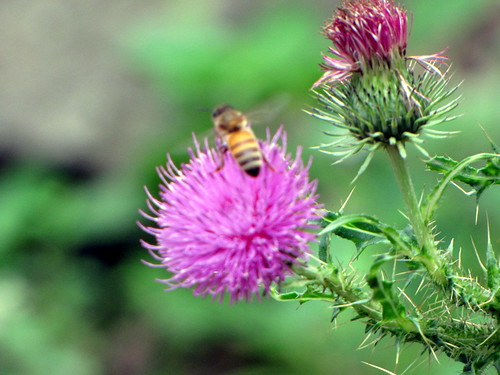
This morning I went up to Andy's to see the bees. When I was there I wondered where they were going. I allowed myself the time to wander from the hive to see where the girls were working. I found some on Queen Ann's Lace, early goldenrod and a kind of thistle I later identified as Canada thistle.

In my wanderings this morning I felt again that searching that I have so many times been party to. I tend to learn from and wander through the natural world when I have given myself some sort of mission. It could be fishing, farming or surfing. I rarely go abroad with binoculars or a guide book to observe for the sake of observation. I don't know if this is good or bad, I just know this is how I am.

When, at liberty this morning, I did wander the fields in search of my girls the great panopoly of things that may be observed by me, were observed by me. There, amidst the grass and thistle, I became again a servant of mission. It is a wonder to think of them aloft above the heads of rich and poor alike, alighting on hundreds of thousands or millions of flowers each day, a thousand times too many for me to even imagine, even had I had the whole day and all the tea in China.

It occurred to me then that for the first time, I was not looking for something for myself, I was looking for where my bees were making their fortune, and that all the work done back at the hive merely prepares them for the changes in the land.

Tuesday, July 13, 2010


Summer has been going great at the apiary. With one exception, every hive we have is a winner! Al Carle, the state bee inspector came by and said our hives looked exceptional. We'll be taking in honey this year for sure.

It's been a banner year, I think anyhow, with great weather and lots of nectar out there. Priscilla and I have worked hard, but it's nothing compared to our "girls."

Because I was curious, I wanted to know how many bee flights there were, on average per hive, per minute. So, I took a stop watch and counted fifty flights, that took around 15 seconds each time. It was hard to count as fast as I saw bees taking off. So, we have about 200 flights per minute per hive. Also, I did this little experiment early in the morning, hardly peak flying time! So, in reality these numbers are low. Still, they are stunning.

I counted the number of honey bee flights per minute and averaged them to come up with this"

200 Flights per minute per hive
1,200 Flights per hour per hive
14,400 Flight per day per hive
100,800 Flights per week per hive
432,000 Flights per month per hive
2,160,000 Flights per year per hive


The following is the number of flights for all our beehives together. We have 20 hives:

4,000 Minute
24,000 Hour
288,000 Day
2,016,000 Week
8,640,000 Month
43,200,000 Year

So, since a bee visits on average 100 flowers per flight, that means
our bees will visit

400,000 Flowers per minute
2,400,000 Flowers per day
28,800,000 Flowers per week
201,600,000 Flowers per month
864,000,000 Flowers per year.

Flower power indeed. I tried to be conservative with my estimates, so it's possible our bees could visit a billion flowers this year. Out bees visited 400,000 in the time it took you to read this. That's nearly half a million flowers.

Monday, June 14, 2010

Book Review: Beekeeping by Werner Melzer


Beekeeping is one of those little books by a company called Barrons that you have undoubtedly seen someplace or other. I have another Barrons book called Plants for Your Aquarium. They produce a lot of titles about pets, and books for the school age educational market.

Oddly, like my aquarium plant book, the Barrons Beekeeping book turns out to be surprisingly good. The paperback volume would just about cover a tea saucer but isn't much more than a centimeter thick. It covers all the basics in adequate detail and even has a pretty good section on honeybee physiology. The book has a sizable number of color pictures, but it's really the illustrations that I like. There are several pen and ink illustrations; one is the Beekeeper's Year that shows the changing conditions and activities within the hive and of the bees. This is shown with the beekeeper's tasks, month by month. Behind it all are two curved lines showing the height of sun in the sky at noon and the amount of brood that should be present in a hive. It's a wonderful illustration well worthy of inclusion of Edward Tufte's Visual Display of Information.

Similarly, there is a nice page showing the life cycle of the bee that allows the novice keeper to easily determine the age of brood. If I could buy these in poster size, I would.

Melzer also devotes a fair amount of time to swarm control, and he advocates a method he calls artificial swarming. It uses the old queen and a method that selects for the same type of bees that would leave in a normal swarm. This is said to satisfy the swarm instinct. I really think that this is the only method of swarm control, as opposed to swarm prevention, that could work.

This book is another from England, and devotes some pages at the start to the bizarre English leaf hive that somehow exists like a bunch of filing cabinets in their own house. Mr. Melzer rightly keeps on track with normal Langstroth hives.

Since this book only costs $9, you should absolutely buy it, if not for the illustrations then for the clear, concise swarm prevention techniques. It's quick and accurate and just right for short reads any time. It's not Bees and Honey, or even Roger Morse, but it's a wonderful short volume.

Saturday, June 12, 2010

Book Review: The Backyard Beekeeper by Kim Flottum


The Backyard Beekeeper is touted as "The Absolute Beginners Guide to Beekeeping" and it's probably about right for that. I would recommend this book to a true beginner.

The first thing that one notices about this book is that it's a fairly large size paperback. Not only does it have far more images than other books on beekeeping with which I am familiar, nearly every illustration is color. Backyard Beekeeping seems far more modern than the other books I own because it is. Published in 2005, this book is part of a wave of publishing for the post-Animal, Vegetable, Miracle crowd. Hives, for the most part, are shown in situ in yards that the Volvo may have just returned to when bringing the kids home from soccer practice or mom back from pilates. Beekeeping in Backyard Beekeeping is hobby beekeeping and hives are kept for pleasure as much as honey. As such, there are recipes and a full-page picture of dried lavender for you to infuse into the cosmetics you'll make from hive products.

In all it does a great job as an introductory text, with clear writing, tons of huge bright color pictures and a focus that more closely matches the goals of most hobbyists.

Mr. Flottum is unusual in that he advocates the use, exclusively, of medium supers for both brood chambers and honey supers. There are many reasons for this. I came to the same conclusion myself last year, before ever having seen this book.

Medium supers are lighter. A full deep can weigh 100 lbs. Too much for me to lift all day. Too much for Priscilla to lift even a few times. He also rightly, IMHO, opines that with one size super you can swap honey comb into the brood chamber if you need to prevent swarming by adding laying area, or swap empty comb into a super if a flow is on. When I switched to only mediums I had this in mind. I've also found during hive body reversals I can better control the brood nest with three mediums rather than two deeps.

The downside is that more supers cost more and they're more labor intensive to construct and paint. Kim goes a step further and suggests using 8 frame equipment rather than standard 10 frame. All this would make a hive of the same volume cost more than twice as much as a standard 10 frame hive with two deep hive bodies and three medium supers.

I found his writing sound and his advice great for the average hobbyist bee keeper for their first year or maybe two.

Where this book falls very short is the short shrift given to swarm prevention. In the long run beekeeping is about mastering the basics--controlling mites and preventing swarms. He devotes more room to both foot cream and salad dressing than he does to swarm prevention. If you're going to succeed in bee keeping you must manage swarms. It's complicated and just plain hard but it has to be done. I'd at least like to have seen 3 pages on this important topic. Optimistically, he devotes less than a page to swarm prevention and even that is part of spring inspections, without it's own heading. Then he gives two pages to catching swarms, which is way more fun to think about.

Backyard Beekeeping is a wonderful addition to the canon and makes beekeeping a lot more accessible. Beautiful in its layout and photography, well written and clear in its articulation, and smart in its advocacy of medium supers for all chores in the hive it's a solid piece of work. If someone you know has signed up for next year's bee keeping classes, buy them this book for Christmas. Then next year, get them Roger Morse.